Two crossing lines: nothing could be simpler, and yet heralds have described hundreds of them. Each cross has a precise shape, a name, a history. Here are the most important, sorted by family, so you can finally recognise them.
A symbol older than Christianity
The cross existed long before Christ: solar wheel, sign of the four directions, mark of ownership, Egyptian ankh. The first Christians avoided it at first, because crucifixion was a shameful punishment; they preferred the fish or the chi-rho, the monogram formed by the Greek letters X and P. The cross only became established from the 4th century, after the conversion of Emperor Constantine and the abolition of crucifixion.
The simple crosses
The Latin cross has a lower arm longer than the other three: it is the shape of the cross of the Passion and the symbol of Western Christianity. The Greek cross has four equal arms; very old, it dominates Byzantine art and Eastern churches, whose floor plan it often draws.
Saint Andrew's cross is X-shaped, called a saltire in heraldry: according to tradition, the apostle Andrew was crucified on a cross of this shape. It appears on the flag of Scotland. Saint Peter's cross is an inverted Latin cross: Peter is said to have asked to be crucified head down, not judging himself worthy to die like Christ. It is a sign of humility, not a hostile symbol.
The Tau cross is T-shaped, with no upper arm. It is the last letter of the ancient Hebrew alphabet, a mark of salvation in the Book of Ezekiel. It is the emblem of Saint Anthony the Great and the Antonines, and Saint Francis of Assisi made it his signature.
The crosses of the orders of knighthood
The cross pattée has arms narrow at the centre that widen towards the ends, like paws. In 1147, Pope Eugene III granted the Templars the right to wear a red cross on their white mantle; it would often take this shape. The Teutonic Knights wore a black cross pattée, ancestor of the German Iron Cross. Lengthened at the bottom, it becomes a pendant or processional cross, like the AIRAIN Crusader's Cross.
The Maltese cross has four V-shaped, notched arms forming eight points. It is the cross of the Knights Hospitaller of Saint John of Jerusalem, who settled in Rhodes and then in Malta in 1530, hence its name. Its eight points are said to recall the eight beatitudes. It is often confused with the cross pattée, whose arms are not notched.
The Jerusalem cross, or cross potent cantoned, is a large cross with T-shaped ends, surrounded by four small crosses. It appears in the arms of the Latin Kingdom of Jerusalem, founded after the First Crusade. It is often read as Christ and the four evangelists.
Each cross has a precise shape, a name, a history.
The decorated crosses
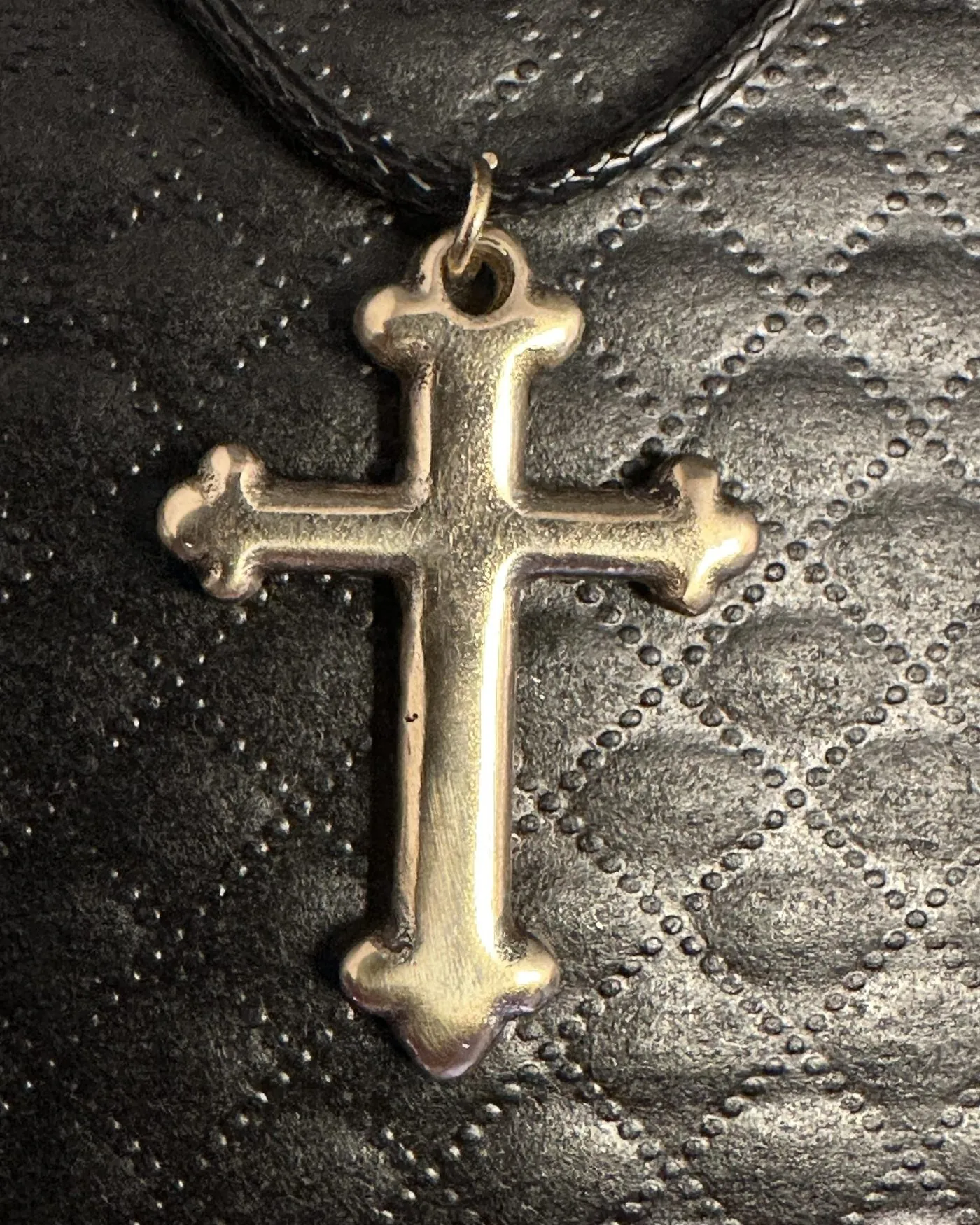
The trefoil cross ends each arm with three lobes, like a clover leaf: a reminder of the Trinity. Widespread in Romanesque and Gothic art, on wayside crosses and tombstones, it is the pilgrims' cross. It inspires the AIRAIN Pilgrim's Cross.
The Occitan cross, or cross of Toulouse, is a Greek cross whose arms each end in three points topped with a ball, twelve balls in all. Emblem of the Counts of Toulouse, it is today the symbol of Occitania. Finally, the Huguenot cross is a Maltese cross with fleurs-de-lis, from which hangs a dove: the sign of French Protestants.
Crosses with several crossbars
The Cross of Lorraine has two crossbars, the shorter at the top, representing the inscription placed above Christ. It comes from a relic of the True Cross venerated by the Dukes of Anjou and then Lorraine, and in 1940 became the emblem of Free France. The Orthodox or Russian cross adds a third, slanted crossbar at the bottom, representing the footrest.
The Celtic cross and the ankh
The Celtic cross surrounds the crossing with a ring. It is seen on the great carved stone crosses of Ireland, Scotland and Brittany, raised from the 8th century onwards. The ring, perhaps inherited from a solar symbol, links heaven and earth.
The ansate cross, or Ankh, has a loop in place of the upper arm. It is the Egyptian hieroglyph for life, long predating Christianity; the Christians of Egypt, the Copts, later adopted it.
The heralds' vocabulary
To describe a cross, heraldry names the shape of its ends: pattée (flared), potent (T-shaped), moline or anchored (anchor-shaped), fleury (fleur-de-lis), pommée (ending in balls), trefoil (clover), crosslet (each arm bears a small crossbar). With these words you can describe almost every cross in the world.
At AIRAIN, three crosses are cast in solid Airain bronze: the Crusader's Cross (pattée), the Pilgrim's Cross (trefoil) and the Ankh (ansata).
Frequently asked questions
What is the Templars' cross?
A red cross, most often pattée, worn on the white mantle from 1147, when Pope Eugene III granted them the right.
What is the difference between a cross pattée and a Maltese cross?
The Maltese cross has V-notched arms forming eight points; the cross pattée has solid arms that flare out.
Is an inverted cross a satanic symbol?
Originally, no: it is the cross of Saint Peter, crucified head down out of humility. Its hostile use is recent.
What does the Cross of Lorraine mean?
Its two crossbars represent the cross and the inscription. Emblem of the Dukes of Lorraine, it became the symbol of Free France in 1940.