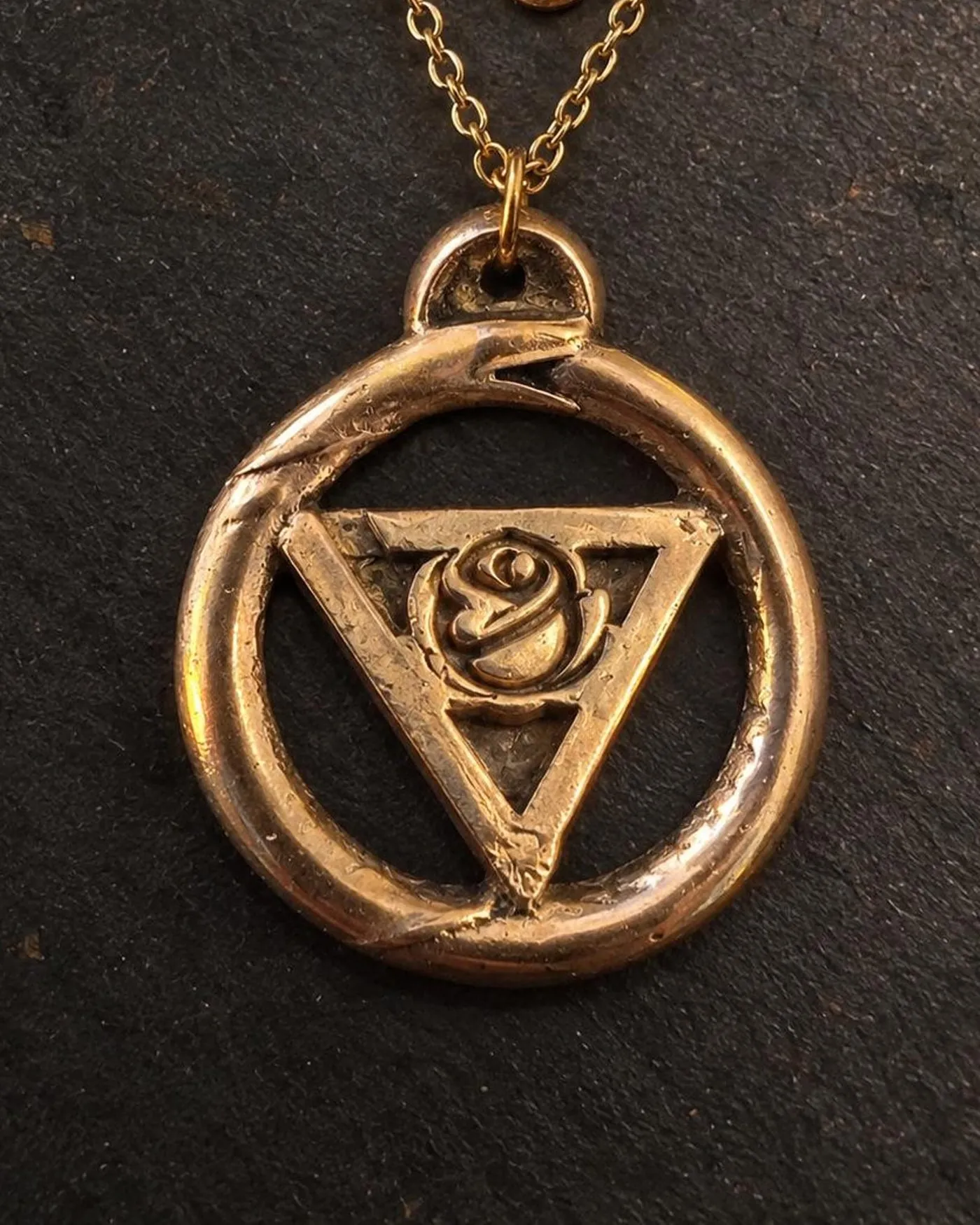
A serpent swallowing its own tail to form a perfect circle. Few symbols have crossed so many centuries and civilisations. Here is where the Ouroboros comes from, what it means, and why people still wear it today.
A Greek name for an Egyptian symbol
The word comes from Ancient Greek: 'oura', the tail, and 'boros', devouring. The Ouroboros is literally 'the one who eats its tail'. But the image is far older than its Greek name.
One of the oldest known depictions is found in the tomb of Tutankhamun, in the 14th century BCE. On one of the gilded shrines around his sarcophagus, two serpents biting their tails encircle a great divine figure: one around the head, the other around the feet. They stand for the beginning and the end of time.
'The All is One': the alchemists' Ouroboros
In Alexandria, the first alchemists took up the serpent. The most famous drawing comes from the Chrysopoeia of Cleopatra, a text probably born in the 3rd century and known from a 10th-century copy. There the serpent encircles three Greek words: 'hen to pan', 'the All is One'.
For the alchemist, matter never vanishes: it transforms. What dies feeds what is reborn, and the work begins again. The Ouroboros thus becomes the image of the Great Work itself, and sometimes of the philosopher's stone.
What dies feeds what is reborn.
What the Ouroboros means today
Over the centuries, from the Gnostics to the Hermeticists, from 17th-century gravestones to modern psychologists, the meaning has stayed the same: the endless cycle, rebirth, the unity of all things, eternity. Wearing it means keeping close the idea that every end prepares a beginning.
The AIRAIN Ouroboros: the serpent, Water and the Rose
In the AIRAIN pendant, the serpent encircles the inverted triangle of Water, the alchemists' feminine element, at the heart of which a rose opens. The eternal cycle protects what blossoms. The piece is sand-cast in recycled Airain bronze, about 90% copper and 10% tin, then finished by hand. Each one keeps the trace of its pour: no two are identical.
Frequently asked questions
What does the Ouroboros mean?
The eternal cycle of life, death and rebirth, the unity of all things ('the All is One') and eternity.
Where does the Ouroboros come from?
From Ancient Egypt: one of the first known depictions adorns a shrine in Tutankhamun's tomb (14th century BCE). It then passed to the alchemists of Alexandria.
Can you wear an Ouroboros every day?
Yes. In solid bronze it can be worn every day and develops a patina over time, which brings out its reliefs.