A small insect pushing a ball in front of it. For the Egyptians, this gesture was that of a god rolling the sun across the sky. The scarab became one of the most worn amulets of Antiquity.
The dung beetle and the sun
The dung beetle forms a ball and rolls it ahead, then lays its eggs in it; the young seem to be born from nothing. The Egyptians saw in it an image of the sun pushed above the horizon every morning, and of life that springs forth by itself.
Khepri, the one who becomes
The god Khepri is the morning sun, depicted with a scarab in place of a head. His name comes from the verb 'kheper': to become, to transform, to come into being. With Ra, the midday sun, and Atum, the evening sun, he forms the cycle of the day.
Kheper: to become.
The amulet of rebirth
The Egyptians wore millions of scarabs in stone, faience or metal. In mummies, a 'heart scarab' was placed on the chest of the deceased, engraved with a chapter of the Book of the Dead, to help them be reborn. The scarab speaks of transformation, protection and new beginnings.
The AIRAIN Khepri Scarab
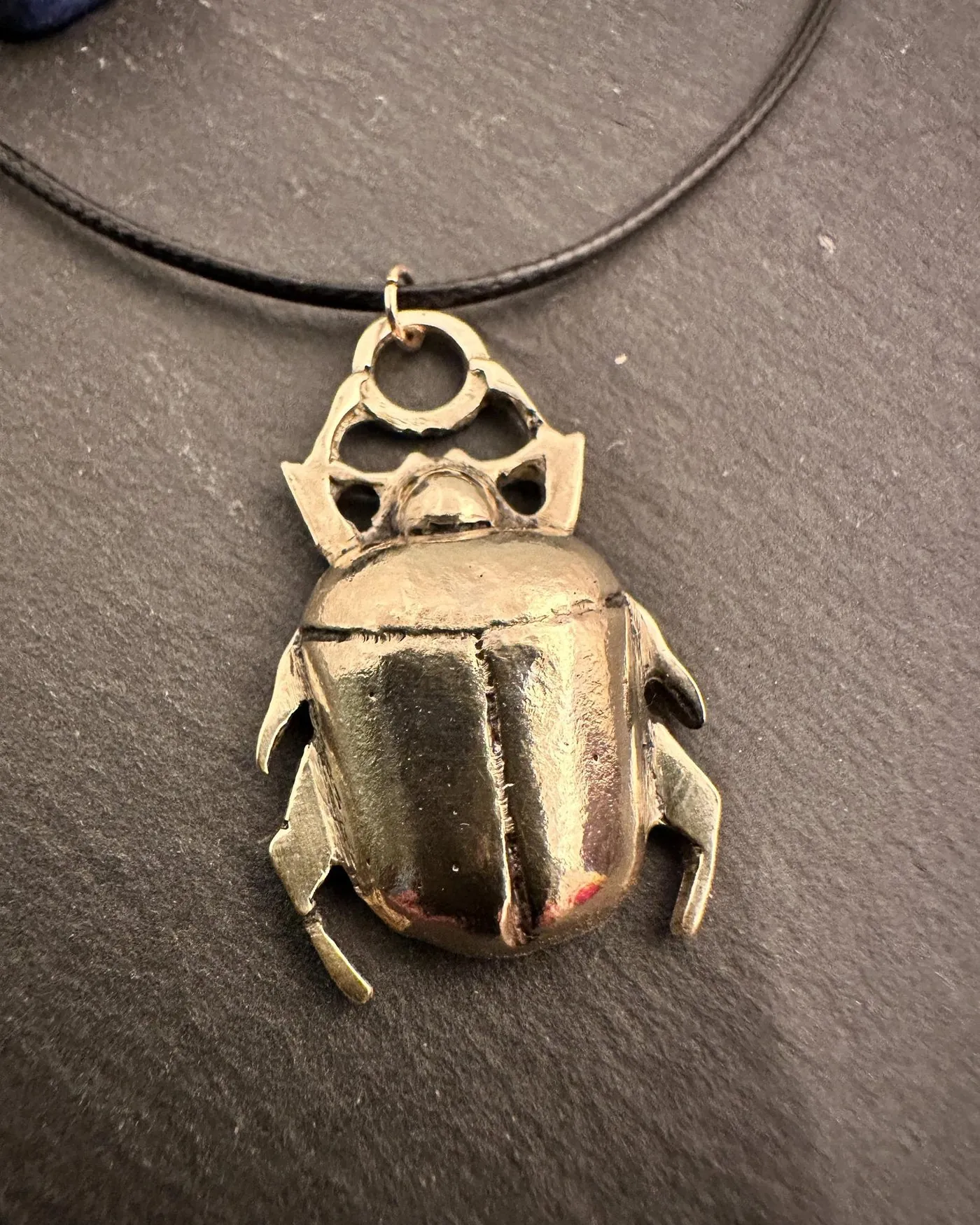
The AIRAIN pendant shows the scarab from above, wings folded, crowned. Sand-cast in solid Airain bronze, it returns to the metal of ancient amulets. A new version, with the sun disc, is being prepared in the workshop.
Frequently asked questions
What does the scarab symbolise in Egypt?
The rising sun, rebirth, transformation and protection.
Who is Khepri?
The Egyptian god of the morning sun, depicted with a scarab head. His name means 'to become'.